

Most ERP evaluations anchor on the subscription price. The better question is what the platform costs to own and run over time, measured against what your current setup is already costing you. Here's how to build a NetSuite TCO model that holds up.
Most ERP evaluations start and end with the subscription price. That's the wrong number to anchor on.
The businesses that make the best ERP decisions are the ones that look at the full picture: what the platform costs to own and operate over time, compared honestly against what their current setup is actually costing them today. Get that comparison right, and the NetSuite conversation looks very different than it does when you're staring at a quote for annual licenses.
Here's how to think about NetSuite's total cost of ownership (TCO), and how to build a realistic case for the investment.
What Total Cost of Ownership Actually Includes
TCO goes well beyond the annual subscription. A complete cost model accounts for every dollar a business spends to select, implement, run, and evolve the platform over its useful life. Five categories make up that number:
Software subscription. The annual license, covering the base platform, user licenses, and any add-on modules. This is the number most buyers start with, but it typically represents only a portion of total first-year cost.
Implementation. The professional services investment required to configure, migrate, integrate, and deploy NetSuite. For most mid-market companies, implementation runs between $25,000 and $100,000 depending on scope and complexity, and it should be budgeted as a separate line item from day one.
Integrations. Connecting NetSuite to existing systems (CRM, ecommerce, payroll, payments, tax compliance) adds cost depending on whether a business uses native connectors, third-party iPaaS tools, or custom-built integrations. These costs sit outside the license and are easy to miss in early budget conversations.
Ongoing support and optimization. Post-go-live support, user training, and system optimization are ongoing investments. The right support model depends on an internal team's capacity and how actively the business plans to expand the platform's capabilities over time.
Internal resources. The time a team spends managing the transition, owning the implementation, and learning the system is a real cost, even if it doesn't show up on an invoice. Factoring in internal resource requirements gives a truer number.
The Hidden Cost of Your Current Stack
One of the most important, and most frequently skipped, parts of a TCO analysis is quantifying what current tools are actually costing a business.
Most mid-market companies aren't running one system. They're running four or five: accounting software, a separate inventory tool, a CRM that doesn't connect to financials, spreadsheets holding everything together, and a reporting process that eats hours of manual work every month.
The cost of that setup isn't just the sum of the subscriptions. It's the staff time spent reconciling data across systems, the delayed closes, the reporting that's always a few days behind, and the operational decisions being made on stale information. Add all of that up and the math on a consolidated platform starts to look different.
A current-state analysis should quantify:
- Monthly hours spent on manual reconciliation and data cleanup, including the time that goes into maintaining integrations and workarounds between disconnected systems
- Average days to close the books each month
- Number of systems finance and operations teams touch to produce a single report
- Annual subscription cost across all tools being replaced or supplemented

Where NetSuite ROI Comes From
NetSuite's return on investment shows up in several places at once, and it compounds as more of the business runs on one platform.
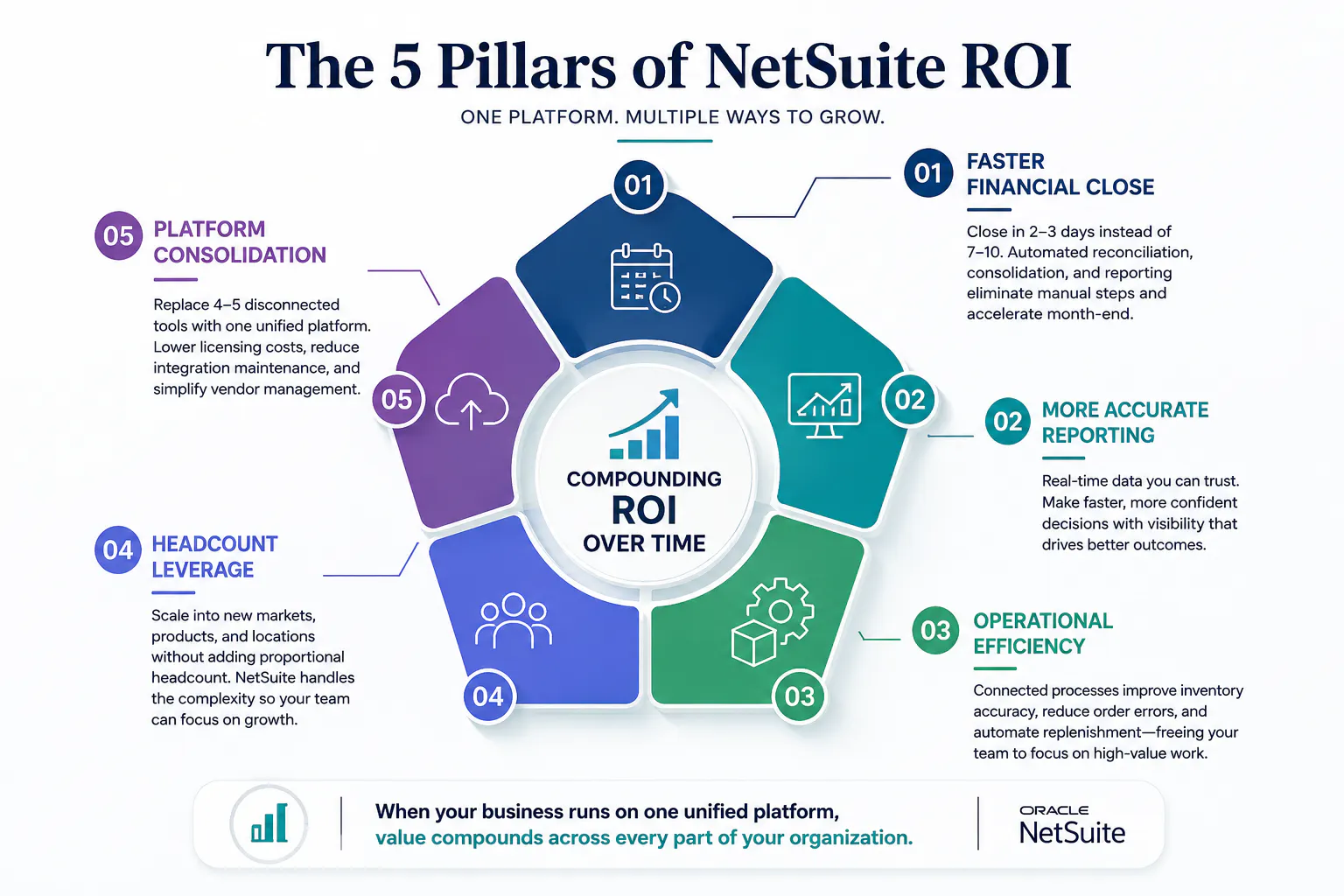
Faster financial close. Close time is the most consistent win we see after go-live. When reconciliation, consolidation, and reporting all happen inside one system, the manual steps that stretch the close disappear. Finance teams that previously closed in 7 to 10 days often get to 2 to 3 days post-implementation.
More accurate reporting. When leadership works from real-time data instead of numbers that are 5 to 10 days old by the time they clear a manual process, decisions get faster and more confident. That advantage widens the longer you run on it.
Operational efficiency. Inventory accuracy improves when purchasing, fulfillment, and financials are connected. Order errors decrease. Replenishment becomes automated. The staff time that was absorbed by manual processes gets redirected toward work that moves the business forward.
Growth without matching headcount. We've watched fast-growing companies on NetSuite add markets, product lines, and locations without a proportional increase in finance and operations headcount. The platform absorbs operational complexity that would otherwise need more people to manage.
Platform consolidation. Replacing four or five disconnected tools with one subscription reduces the licensing cost, integration maintenance, and vendor management burden that accumulates quietly across growing businesses.
How to Build a Realistic Cost Model
A credible TCO analysis takes less than most buyers expect: the right questions, answered honestly.
Start with current-state cost. Add up subscription spend across all tools being replaced, plus a realistic estimate of staff time absorbed by manual processes.
Build the NetSuite number. Break out license, implementation, integrations, and ongoing support as separate line items.
Model over three to five years. Year-one cost looks very different from year-three cost once implementation is behind you and the platform is running efficiently. Factor in what the current stack would cost to maintain over the same period as the business grows, including the integrations and workarounds that get more expensive as complexity increases.
Pressure-test the assumptions. The most common mistake is underestimating implementation cost and overestimating how quickly productivity gains materialize.
The businesses that get the most accurate picture involve both finance and operations in the analysis, because the savings show up in both places.
Build Your TCO Model With Luxent
We've built TCO models for mid-market companies across a range of industries and complexity levels. We know which costs are easy to miss, which assumptions are usually too optimistic, and where the real return tends to show up, and when.
If you're early in your evaluation and want a clear picture of what NetSuite would actually cost and return for your business, a TCO conversation is the best place to start.
Frequently Asked Questions
For companies that have outgrown basic accounting software, NetSuite is typically one of the most cost-effective platforms available when evaluated on total cost of ownership rather than subscription price alone.
The consolidation savings from replacing multiple tools with one platform often cover a large share of the annual investment.
Cloud ERP is typically less expensive than on-premise ERP over a multi-year horizon once total cost is accounted for. It eliminates the hardware, infrastructure, and IT maintenance costs that come with on-premise systems, and it removes the need for managed upgrades.
NetSuite releases two product updates per year automatically, without the risk of breaking customizations that comes with on-premise upgrade cycles.
Most mid-market companies see meaningful ROI within the first 12 to 24 months post go-live. The strongest gains come from close time reduction, reporting accuracy, and operational efficiency.
The companies that get there fastest share one trait: they scoped their implementation tightly and didn't try to build everything at once.
Evaluating the subscription in isolation, without budgeting for implementation, integrations, and internal resource requirements.
The second most common mistake is over-building at go-live: adding modules and customizations that stretch the project timeline and push back the point where the business starts seeing returns.
Yes, and ideally before talking to anyone. Walking into a vendor conversation with a clear picture of current-state cost and a realistic budget for the full investment puts a buyer in a much stronger position.
It also helps in evaluating proposals on their merits rather than anchoring on the subscription line item.
Results referenced in this article are directional and based on industry patterns for mid-market companies. Actual costs and returns vary based on configuration, contract terms, and business complexity.